Testing and Inspection
Smoke Shaft Testing
It covers smoke shaft air tightness testing and AOV testing. It is booked by main contractors and smoke control installers before handover, and by building managers who need evidence that the system still works.
What the smoke shaft and AOV testing record contains
- Identification of the shaft and the tested system configuration.
- The leakage criterion supplied for the particular installation.
- Measured leakage and the conditions under which it was obtained.
- A record of the vent and damper checks included in the instruction.
- Observed defects and limitations affecting interpretation of the results.
- References suitable for cross-checking the smoke control handover documents.
How smoke shaft and AOV testing is arranged
- You send the smoke ventilation design, the shaft drawings and the leakage rate set by the designer.
- We book a test once the shaft is complete, sealed and the vents and dampers are installed.
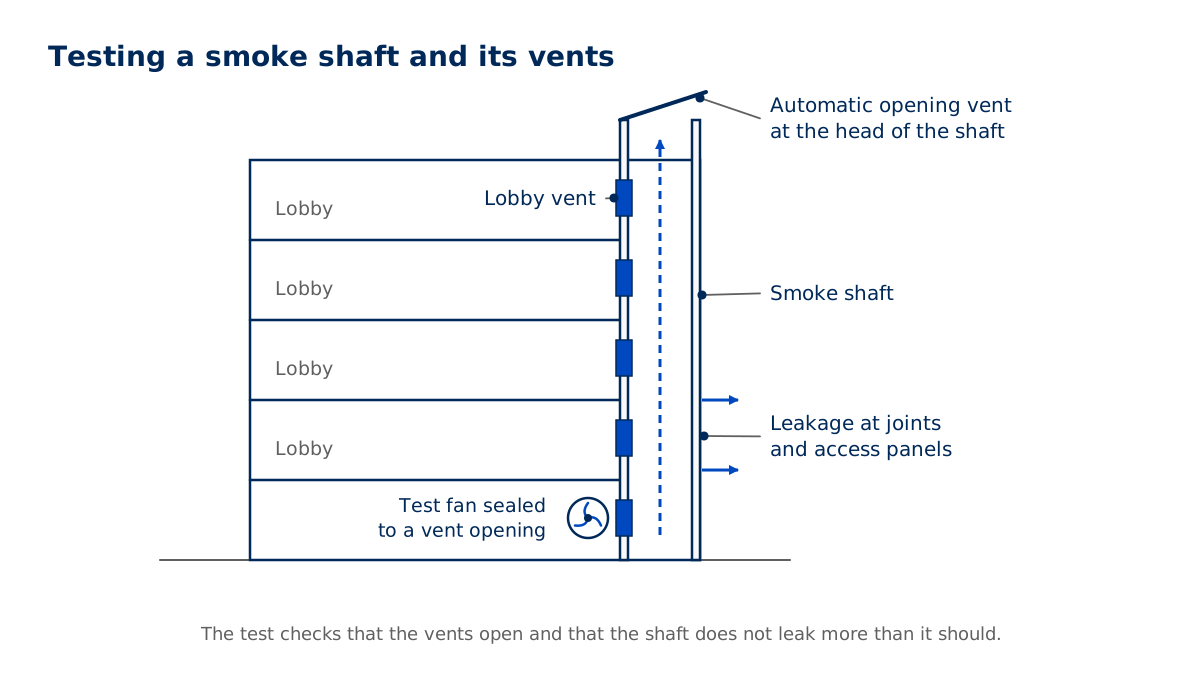
- Openings into the shaft are closed and a calibrated fan pressurises the shaft.
- Air leakage is measured and compared with the leakage rate set by the smoke ventilation system designer.
- AOVs and dampers are operated to check they open and close as designed.
- We issue the test report for the contractor, the designer and the building control body.
Records supplied after smoke shaft and AOV testing
You receive a test report showing the measured leakage against the designer's target, the test conditions and equipment calibration, and the results of AOV and damper operation checks. Contractors include it in the handover and fire safety information. Building managers keep it as evidence of maintenance.
Where the system is tested again during the life of the building, the report records the same measurements so results can be compared over time. Building managers can use it alongside servicing records for the smoke control system.
When smoke shaft and AOV testing is needed
Approved Document B gives guidance on smoke control in the common escape routes of blocks of flats, including smoke shafts and automatic opening vents. The design of each system, including the leakage rate the shaft must achieve, is set by the smoke ventilation system designer.(Source: Approved Document B: Fire safety (GOV.UK))
Once the building is occupied, the Regulatory Reform (Fire Safety) Order 2005 requires the responsible person to keep facilities provided for fire safety, such as smoke ventilation, maintained in efficient working order and good repair.(Source: Approved Document B: Fire safety (GOV.UK); Regulatory Reform (Fire Safety) Order 2005, article 17: maintenance (legislation.gov.uk))
Preparing information for smoke shaft and AOV testing
- Current shaft drawings showing dimensions, levels, vents, dampers and service penetrations.
- The smoke control designer leakage criterion and agreed test method.
- The cause-and-effect schedule identifying intended vent and damper responses.
- Confirmation of completed shaft sealing and access to the relevant lobbies and roof equipment.
- Arrangements for power, controls specialist attendance and coordination with the site team.
Projects that use smoke shaft and AOV testing
| New apartment blocks | Coordinate shaft completion with control panel readiness so the planned checks can be witnessed together. |
|---|---|
| System alterations | Identify changed dampers, openings and controls before agreeing which checks the altered installation needs. |
| Building management | Provide earlier reports and defect records so the visit addresses known concerns as well as current operation. |
What affects the cost of smoke shaft and AOV testing
Smoke shaft and AOV testing costs depend on shaft geometry, the openings involved and the agreed control checks. Access at each level and attendance by the controls specialist affect the programme. Confirm designer criteria and system readiness before booking, particularly where different contractors are responsible for sealing and controls.
Price: [[TO SUPPLY: Smoke Shaft and AOV Testing price from]]. Turnaround: [[TO SUPPLY: Smoke Shaft and AOV Testing turnaround time]].
Shaft leakage and readiness checker
How this tool decides
Designer leakage target (same units as reading)
Enter your measured or project figure.
Measured leakage (same units as target)
Enter your measured or project figure.
Number of shafts
Enter your measured or project figure.
Shaft complete, penetrations sealed and vents fitted?
- Yes
- No
Power and controls engineer available?
- Yes
- No
Use the same pressure, units and measurement basis as the designer’s target; no generic leakage limit is applied. Approved Document B: Fire safety (GOV.UK)
No
Finish and seal the shaft before booking the leakage and operation tests.
The designer sets the leakage target; completed linings, penetrations and vents are needed for the test described on this page. Approved Document B: Fire safety (GOV.UK)
Typical project: from £600 per shaft.
Indicative only. This is a typical UK market range based on prices published by other providers, checked November 2026. It is not a quote. Prices exclude VAT unless stated. Contact us for an accurate price for your project.
Based on one published price.
Checked November 2026.
Next step: Finish installation and send the designer’s leakage target and shaft drawings.
Deadline: Before handover, allowing time for remedial work.
No
Arrange power and a controls engineer so AOV and damper operation can be checked.
A leakage comparison does not demonstrate that AOVs and dampers operate correctly. Approved Document B: Fire safety (GOV.UK)
Typical project: from £600 per shaft.
Indicative only. This is a typical UK market range based on prices published by other providers, checked November 2026. It is not a quote. Prices exclude VAT unless stated. Contact us for an accurate price for your project.
Based on one published price.
Checked November 2026.
Next step: Confirm controls availability and keep shaft openings closed during the test.
Deadline: Before handover, allowing time for remedial work.
Otherwise / result rule
Compare the measured leakage with the designer’s target and arrange AOV and damper operation checks.
At or below the user-supplied target meets that leakage comparison only; the final test report also records system operation. Approved Document B: Fire safety (GOV.UK)
Typical project: from £600 per shaft.
Indicative only. This is a typical UK market range based on prices published by other providers, checked November 2026. It is not a quote. Prices exclude VAT unless stated. Contact us for an accurate price for your project.
Based on one published price.
Checked November 2026.
Next step: Send the design and readings to the tester and smoke control designer.
Deadline: Before handover, allowing time for remedial work.
What to have ready
- Current shaft drawings showing dimensions, levels, vents, dampers and service penetrations.
- The smoke control designer leakage criterion and agreed test method.
- The cause-and-effect schedule identifying intended vent and damper responses.
- Confirmation of completed shaft sealing and access to the relevant lobbies and roof equipment.
- Arrangements for power, controls specialist attendance and coordination with the site team.
How we work this out
The figures shown are indicative. They are ranges taken from prices that UK providers of this service have published, and they are here to help you budget. They are not a quote, an offer or a price guarantee from National Building Compliance.
Your actual price depends on details this tool cannot see, including the size and layout of the building, how many units there are, access, location, how complete your drawings are, and how quickly you need the work. It may be lower or higher than the range shown.
Unless a figure says otherwise, prices exclude VAT. The date each range was last checked is shown beside it.
For an accurate, fixed price, send us your project details. We will confirm the scope and quote before any work is booked.
Indicative market costs
| Case | Unit | Indicative range |
|---|---|---|
| Typical project | per shaft | from £600 Indicative only. This is a typical UK market range based on prices published by other providers, checked November 2026. It is not a quote. Prices exclude VAT unless stated. Contact us for an accurate price for your project. |
Based on one published price.
Checked November 2026.
Smoke Shaft and AOV Testing for typical project in England typically costs from £600 per shaft before VAT, based on prices published by UK providers and checked in November 2026. This is indicative and not a quote.
Indicative only. This is a typical UK market range based on prices published by other providers, checked November 2026. It is not a quote. Prices exclude VAT unless stated. Contact us for an accurate price for your project.
Avoiding problems with smoke shaft and AOV testing
| Conflicting drawings | Resolve differences between shaft drawings and control schedules before assigning test references. |
|---|---|
| Unavailable controls support | A powered panel alone may not allow the agreed operating sequence to be demonstrated. |
| Undocumented setup | Record temporary closures so later users understand the conditions behind the leakage figure. |
Understanding the outcome of smoke shaft and AOV testing
Leakage is usually found at service penetrations, around vent and damper frames, at the junctions of shaft linings and at the head and base of the shaft. Sealing these before the test, and inspecting the shaft as it is built, reduces the chance of a retest.
The test cannot be completed while trades are still working in the shaft or opening doors onto it. Agree a test window with the site team so the shaft and lobbies stay closed during the test.
Testing is usually arranged so the controls engineer can operate vents and dampers during the same visit, which keeps the number of site visits down. We coordinate the timing with your installer and the site team.
Questions about smoke shaft and AOV testing
When should a smoke shaft be tested?
Once the shaft is complete and sealed and the vents and dampers are installed, before handover. Allow time for remedial sealing and a retest.
What leakage rate does the shaft need to meet?
The leakage rate set by the smoke ventilation system designer for that building. It should be stated in the design.
Who can carry out the test?
A tester with experience of shaft air tightness testing and calibrated equipment. Ask for evidence of both, and agree the method with the designer before the test.
Do AOVs need testing after handover?
The responsible person must keep fire safety facilities maintained in efficient working order. Regular operation checks and servicing are the usual way to show this.
How much does smoke shaft testing cost?
It depends on the number and height of shafts. Published prices: [[TO SUPPLY: price from]].
What happens if the shaft fails?
The tester identifies where air is leaking, the contractor seals those points, and the shaft is retested until it meets the leakage rate set by the designer.
Request a quote
Tell us about the project once. We will confirm which services apply and send a quote.
All fields marked * are required.