
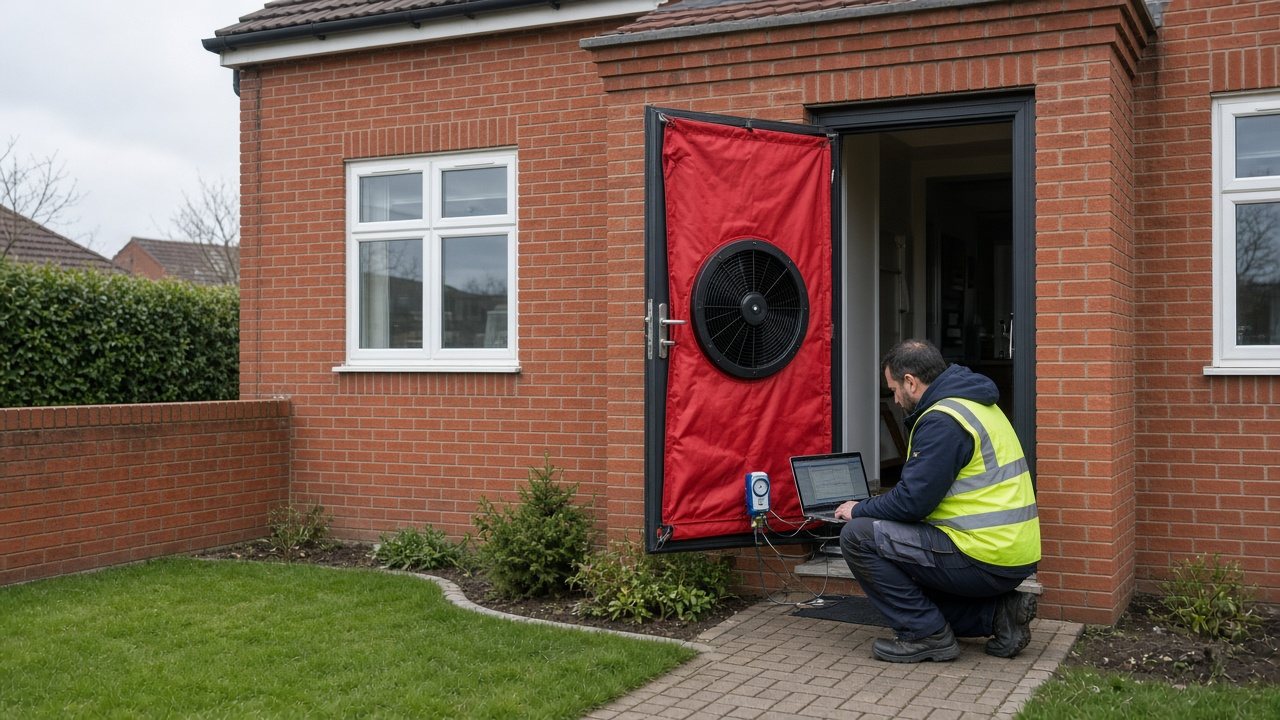
Reading an air tightness result without losing its context
An air permeability result expresses leakage through the building envelope relative to its area under the stated test pressure. It is not a direct measurement of the air occupants receive during everyday use. Wind, temperature, fan operation and the position of vents all affect real conditions, so the certificate should not be read as a promise about indoor air quality.
For energy compliance, Approved Document L connects pressure testing with the completed building’s energy assessment. A result below a general limiting value can still leave the energy calculation short if the design relied on a tighter envelope. Ask the energy assessor to check the measured figure against the actual design assumptions before describing the project as passed.
Comparing an air tightness result with the right target
Keep the design target, measured result and final energy assessment together. They answer different questions. The target tells the builder what the design expected. The measurement records the tested condition. The final calculation shows how that condition interacts with insulation, heating, glazing and the other energy inputs. Our SAP calculation and EPC guide explains why the calculation and certificate have different roles.
For a self-build home, start with the latest design information rather than the target printed on an early quotation. Changes to glazing or heating may have altered the assumptions since the first assessment. For a development, check the plot reference carefully. Similar-looking homes can have different envelope areas, layouts or specifications, and a neighbouring plot’s result is not evidence for yours.
| What you find | What to check before deciding |
|---|---|
| The result meets the design target | Ask whether the completed energy assessment uses that measured result and the installed specification. |
| The result misses the design target | Ask the energy assessor to review the calculation and the builder to investigate leakage before selecting a remedy. |
| The result is much lower than expected | Check the test boundary and preparation, then review whether the installed ventilation remains suitable. |
Why a very low air tightness result needs a ventilation review
Uncontrolled draughts are an unreliable way to supply fresh air. Sealing them can improve the envelope while leaving a separate question about how moisture and pollutants leave occupied rooms. Approved Document F describes ventilation provision for dwellings, including background, extract and purge ventilation. Assess the installed system against the applicable guidance rather than leaving accidental gaps to compensate for missing ventilation.
If the measured envelope differs substantially from the ventilation designer’s assumptions, give the designer the report. A fan that runs is not proof that its installed airflow is sufficient. Duct resistance, controls and air transfer routes matter too. The Part F ventilation certificate guide explains the records that help connect the equipment with measured performance.
Checking an unexpected air tightness result before remedial work
Begin with the evidence rather than a tube of sealant. Confirm that the address, envelope area and tested spaces match the drawings. Ask the tester to explain the preparation and any limitations. An unfinished service opening and an incorrectly described test boundary need different responses. Record which parts of the building were accessible so later reviewers can understand what was actually tested.
If leakage needs investigation, ask for locations and likely routes, not just a broad instruction to seal everything. A concealed gap can connect several rooms or cavities. The air test preparation guide covers checks before finishes hide those routes. Repairs should preserve the intended operation of fans, drains, doors and other components instead of making the test result the only objective.
- Compare the measured figure with the target recorded for your own plot, rather than a figure quoted for a different building.
- Check that the report describes the completed envelope, including the correct address, test boundary and building dimensions.
- Treat intentional ventilation and unintended leakage as separate subjects when reviewing a low result.
About our Air Tightness Testing service
For the service itself, see Air Tightness Testing.
Using the air tightness result in your completion records
Send the report to the person coordinating the final energy assessment and keep its revision with the project records. Identify any remedial work and later testing clearly. Approved Document L says results, including unsuccessful tests, should be reported to the building control body. A favourable later result does not make the earlier testing history disappear.
When asking us to arrange air tightness testing, include the latest plans, design target and any previous reports. National Building Compliance provides one contact to arrange accredited, qualified assessors and coordinate the evidence needed for the project. If several completion documents are outstanding, the new build compliance package helps you identify which appointments and reports need to fit around the remaining works.