
Design and Planning
BS 4142 Noise Assessment
It is also called a commercial noise assessment or plant noise assessment. Councils commonly ask for one when new plant is proposed near homes, when a commercial use moves in next to residents, or when a condition limits noise from a site.
Send the site address, plant details and any condition and we will confirm the survey needed.
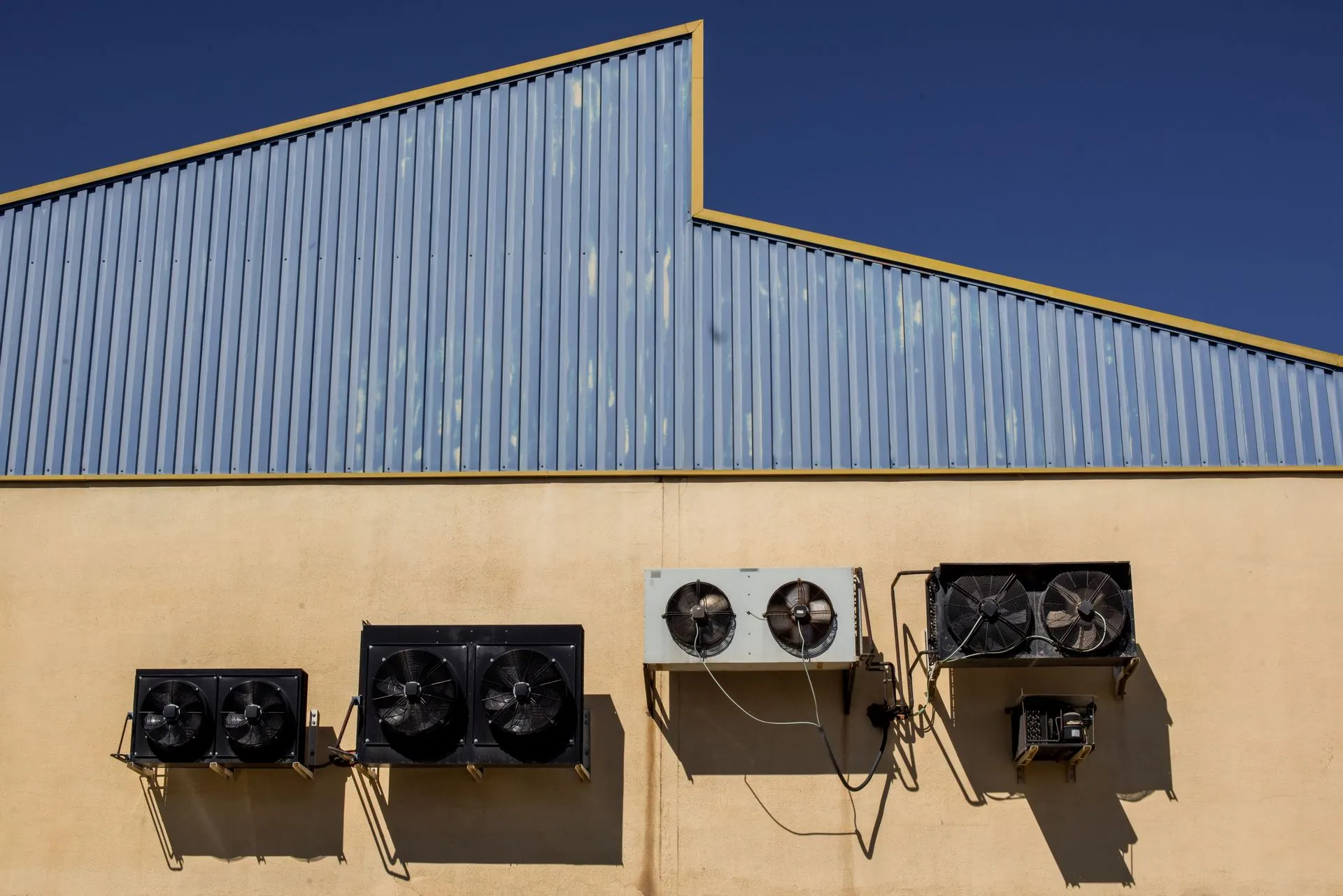
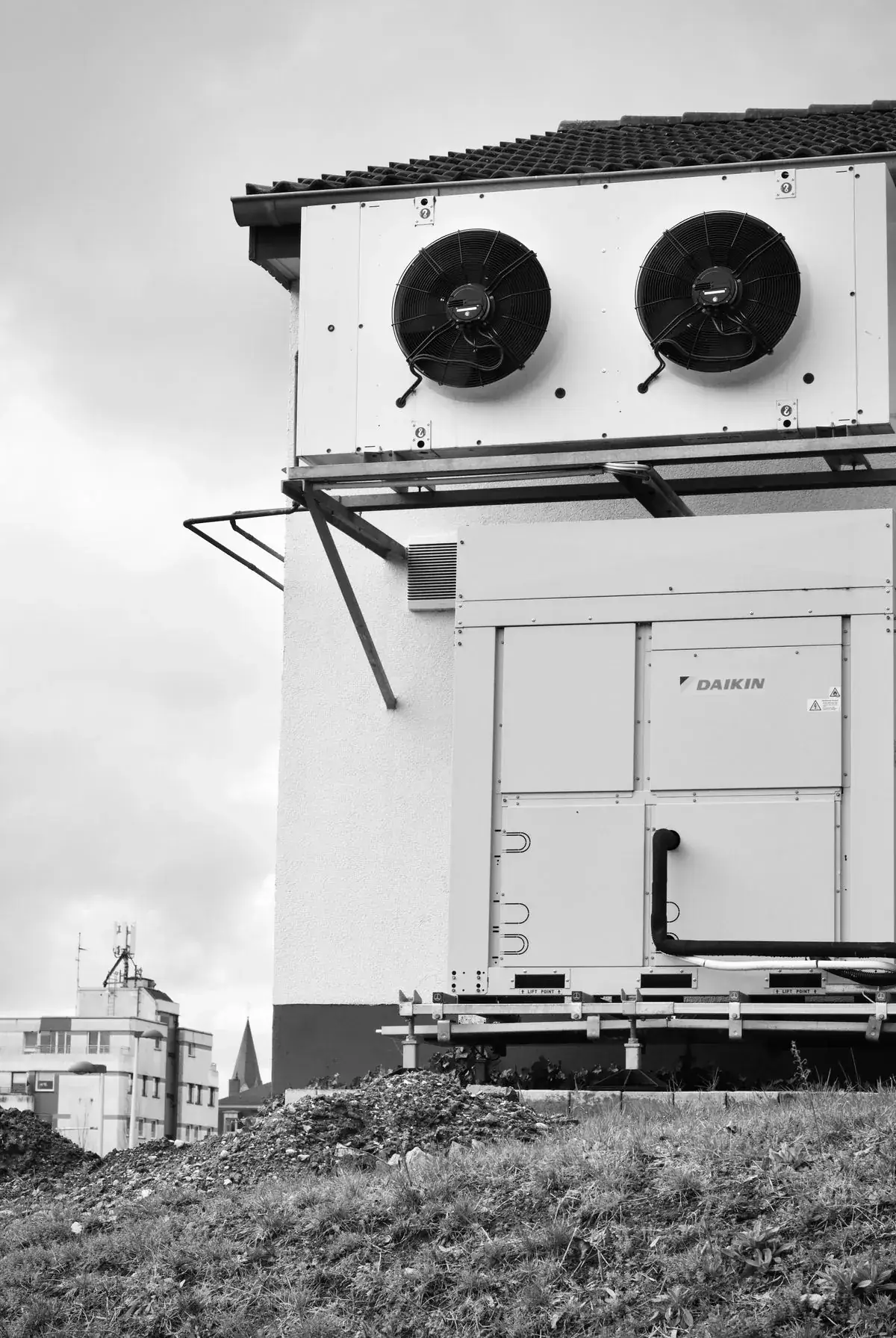
Heat pumps and air conditioning units on homes and small businesses are a common reason for an assessment. Larger schemes include supermarket plant, extraction for restaurants, deliveries and industrial units.
The a BS 4142 noise assessment submission package
- A source register tied to equipment references.
- The operating scenario used for the assessment.
- A plan identifying source and receiving positions.
- An explanation of sound data and calculation assumptions.
- Mitigation recommendations linked to the assessed installation.
Your a BS 4142 noise assessment report
A BS 4142 assessment report with the survey results, plant or source data, the rating and assessment, the context considered and any mitigation. Planning officers and environmental health teams use it to decide applications, discharge conditions or respond to complaints.(Source: BSI: BS 4142 Methods for rating and assessing industrial and commercial sound)
Where plant has not been chosen yet, the report can set a design limit that the selected equipment must meet, which gives the mechanical engineer a clear target.
Avoiding problems with a BS 4142 noise assessment
| Unsuitable manufacturer data | Check that the figures describe the selected unit and its intended operating duty. |
|---|---|
| Omitted concurrent sources | Include other equipment that can run at the same time. |
| Impractical enclosure | Check access, cooling and maintenance before accepting an acoustic treatment. |
When a BS 4142 noise assessment is needed
BS 4142, published by BSI, describes methods for rating and assessing sound of an industrial or commercial nature. It is the standard method councils refer to when assessing plant and commercial sound at nearby homes.(Source: BSI: BS 4142 Methods for rating and assessing industrial and commercial sound; GOV.UK: Planning practice guidance, Noise; GOV.UK: National Planning Policy Framework)
GOV.UK planning practice guidance on noise explains how planning should handle noise from existing and new businesses, including the 'agent of change' principle, where the party introducing a new use is responsible for mitigation. Planning requirements differ by council. The local planning authority, usually advised by its environmental health team, decides what assessment it needs and may set the scope in a pre-application response or a planning condition.
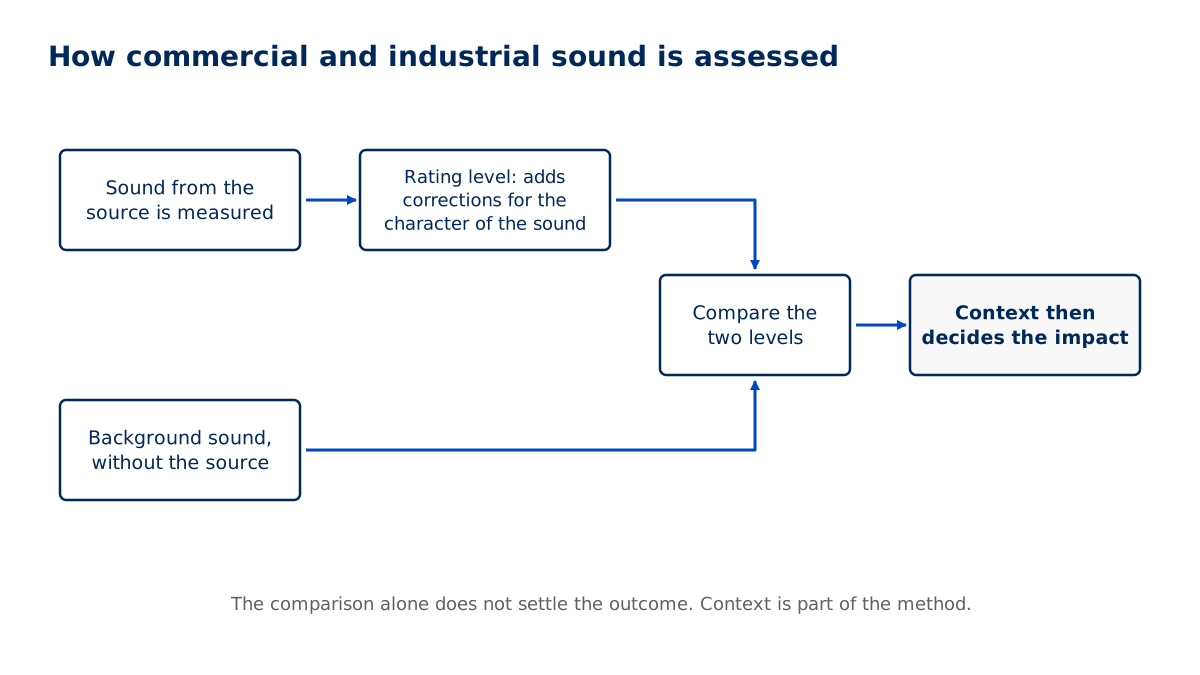
BS 4142 considers the character of the sound, such as tones, impulses and intermittency, as well as its level, and the context of the site. The consultant explains how each factor was assessed.(Source: BSI: BS 4142 Methods for rating and assessing industrial and commercial sound)
Pricing and scheduling a BS 4142 noise assessment
The number of sources, operating modes and nearby receiving locations affects the assessment work. Existing equipment may need measurements, while proposed plant needs suitable manufacturer data. Agree the operating scenario before modelling, since revised equipment selections or extended operating proposals can change both the analysis and the mitigation.
Price: [[TO SUPPLY: Commercial and Industrial Noise Surveys price from]]. Turnaround: [[TO SUPPLY: Commercial and Industrial Noise Surveys turnaround time]].
Commercial plant register estimator
How this tool decides
Council condition or complaint reference
Enter the location or project description.
Equipment and source-data reference
Enter the location or project description.
Operating hours
Enter the location or project description.
Runs at night
- Yes
- No / not confirmed
Nearest windows and room use
Enter the location or project description.
Tonal or intermittent character known
- Yes
- No / not confirmed
night: yes: Night operation requires representative background evidence and review at receiving homes.
character: yes: Tonal or intermittent character needs source evidence and consultant assessment; no penalty has been assumed.
Otherwise / result rule
Send the plant register, source data and receiving-window locations for a scoped commercial sound assessment.
The page’s BS 4142-backed copy identifies night operation near bedrooms and tonal/intermittent character as issues needing assessment in context; no decibel rating is calculated. GOV.UK planning practice guidance on noise
Typical project: £600 to £2,800 per assessment, single source.
Indicative only. This is a typical UK market range based on prices published by other providers, checked November 2026. It is not a quote. Prices exclude VAT unless stated. Contact us for an accurate price for your project.
Checked November 2026.
Next step: Send the recorded project details and the page preparation list with your enquiry so we can confirm scope and quote.
Deadline: Confirm the submission or design deadline with the project team.
What to have ready
- A scaled plant or premises layout showing boundaries and nearby homes.
- Manufacturer sound data identifying the proposed equipment and operating condition.
- Proposed operating hours, duty cycles and simultaneous equipment use.
- Details of deliveries, loading activity and other relevant sound sources.
- Existing background measurements and the council's commercial noise request.
How we work this out
The figures shown are indicative. They are ranges taken from prices that UK providers of this service have published, and they are here to help you budget. They are not a quote, an offer or a price guarantee from National Building Compliance.
Your actual price depends on details this tool cannot see, including the size and layout of the building, how many units there are, access, location, how complete your drawings are, and how quickly you need the work. It may be lower or higher than the range shown.
Unless a figure says otherwise, prices exclude VAT. The date each range was last checked is shown beside it.
For an accurate, fixed price, send us your project details. We will confirm the scope and quote before any work is booked.
Indicative market costs
| Case | Unit | Indicative range |
|---|---|---|
| Typical project | per assessment, single source | £600 to £2,800 Indicative only. This is a typical UK market range based on prices published by other providers, checked November 2026. It is not a quote. Prices exclude VAT unless stated. Contact us for an accurate price for your project. |
Checked November 2026.
Commercial and Industrial Noise Surveys for typical project in England typically costs £600 to £2,800 per assessment, single source before VAT, based on prices published by UK providers and checked in November 2026. This is indicative and not a quote.
Indicative only. This is a typical UK market range based on prices published by other providers, checked November 2026. It is not a quote. Prices exclude VAT unless stated. Contact us for an accurate price for your project.
Information for a BS 4142 noise assessment
- A scaled plant or premises layout showing boundaries and nearby homes.
- Manufacturer sound data identifying the proposed equipment and operating condition.
- Proposed operating hours, duty cycles and simultaneous equipment use.
- Details of deliveries, loading activity and other relevant sound sources.
- Existing background measurements and the council's commercial noise request.
Preparing the commercial and industrial noise assessment
01
You send the site plan, plant schedule or details of the commercial use.
02
The consultant identifies the nearest homes and agrees scope with the council where needed.
03
Background sound is measured at representative positions, typically including night time.
04
Sound from the proposed plant or activity is measured or predicted from manufacturer data.
05
The sound is rated and assessed using BS 4142.
06
Mitigation is specified if needed: enclosures, barriers, silencers, relocation or operating hours.
07
You receive the report for the planning application or the council.
08
Once plant is installed, a commissioning check can confirm the levels.
Improving a commercial plant noise assessment outcome
Plant placed close to bedroom windows, running at night when background sound is lowest, is the usual problem. Siting, screening and choosing quieter units at design stage cost far less than retrofitting enclosures.
The BSI description of BS 4142 identifies it as a method for rating and assessing industrial and commercial sound. Give the consultant information about audible tones and intermittent operation as well as overall sound data.
Ask for the assessment before plant is ordered. Changing a unit or its position on paper is simple; moving it once installed is not.
Projects needing a BS 4142 noise assessment
- New external plant
- Assess location options while equipment can still move on the drawings.
- Expanded premises
- Separate the proposed change from retained activity so its contribution can be understood.
- Changed operating patterns
- Explain the proposed duty profile instead of relying solely on the equipment schedule.
Questions about a BS 4142 noise assessment
What is BS 4142?
The British Standard describing methods for rating and assessing industrial and commercial sound.
Do heat pumps need a BS 4142 assessment?
Sometimes. Where a council asks for a noise assessment for heat pumps or other plant near homes, BS 4142 is the usual method.
Can you assess an existing noise complaint?
Yes. The same method can be used to assess existing commercial sound.
What mitigation is typical?
Acoustic enclosures, barriers, silencers, relocating plant, or limiting operating hours.
How much does a BS 4142 assessment cost?
Published prices: [[TO SUPPLY: price from]]. Turnaround: [[TO SUPPLY: turnaround time]].
Can the assessment set limits for plant not yet chosen?
Yes. The report can set a design limit that the selected equipment must meet at the nearest homes.
Request a quote
Tell us about the project once. We will confirm which services apply and send a quote.
All fields marked * are required.